Cold Plunge for Beginners: How Cold, How Long, How Often
You've seen the tubs, the ice baths, the morning routines. But how do you actually start cold plunging without shocking your system or quitting after day two? Below is a conservative starting example — the cautious end of what experienced plungers commonly do, written down so you have somewhere to begin.
How cold should the water be?
Common practice: beginners typically start around 15°C / 59°F rather than near-freezing, and work down toward roughly 10–12°C / 50–54°F over a period of weeks. The near-freezing numbers you see online come from experienced plungers.
What the evidence says: there is no established optimal temperature. Research on cold water immersion covers a broad range of temperatures and does not identify one as correct. What the literature does establish clearly is the risk side: the cold shock response — an involuntary gasp, rapid uncontrolled breathing and a jump in heart rate and blood pressure — is strongest in water in the roughly 10–15°C band and is a documented cause of drowning and cardiac events. Colder is therefore more dangerous, not automatically more beneficial. Not independently confirmed by PlungeWise — we have not run temperature trials.
How long should you stay in?
Common practice: a typical progression looks like this. These are conventions, not doses.
- First few sessions: 30–60 seconds. Just get in, breathe, get out.
- After a couple of weeks: 1–2 minutes.
- Experienced: 2–3 minutes. Longer is not established as better.
What the evidence says: you will often see a figure of "about 11 minutes of cold exposure per week" quoted online. That number is a popular-media summary, not a clinical recommendation — it was derived from discussion of a small 2021 study of winter swimmers with a sauna component, and no health authority has adopted it as a target. We are not repeating it as a goal. Treat total weekly time as something you build slowly and stop increasing the moment it stops feeling manageable.
How often?
Common practice: two to four sessions a week is the rhythm most beginners are pointed toward, and consistency is generally valued over frequency.
What the evidence says: no frequency has been established as optimal or as safe for everyone. If you lift weights, note one reasonably well-replicated finding: cold water immersion immediately after strength training blunted some muscle adaptation in a controlled trial, so separating cold exposure from strength sessions by several hours is a reasonable precaution if hypertrophy is your goal.
The breathing part matters most
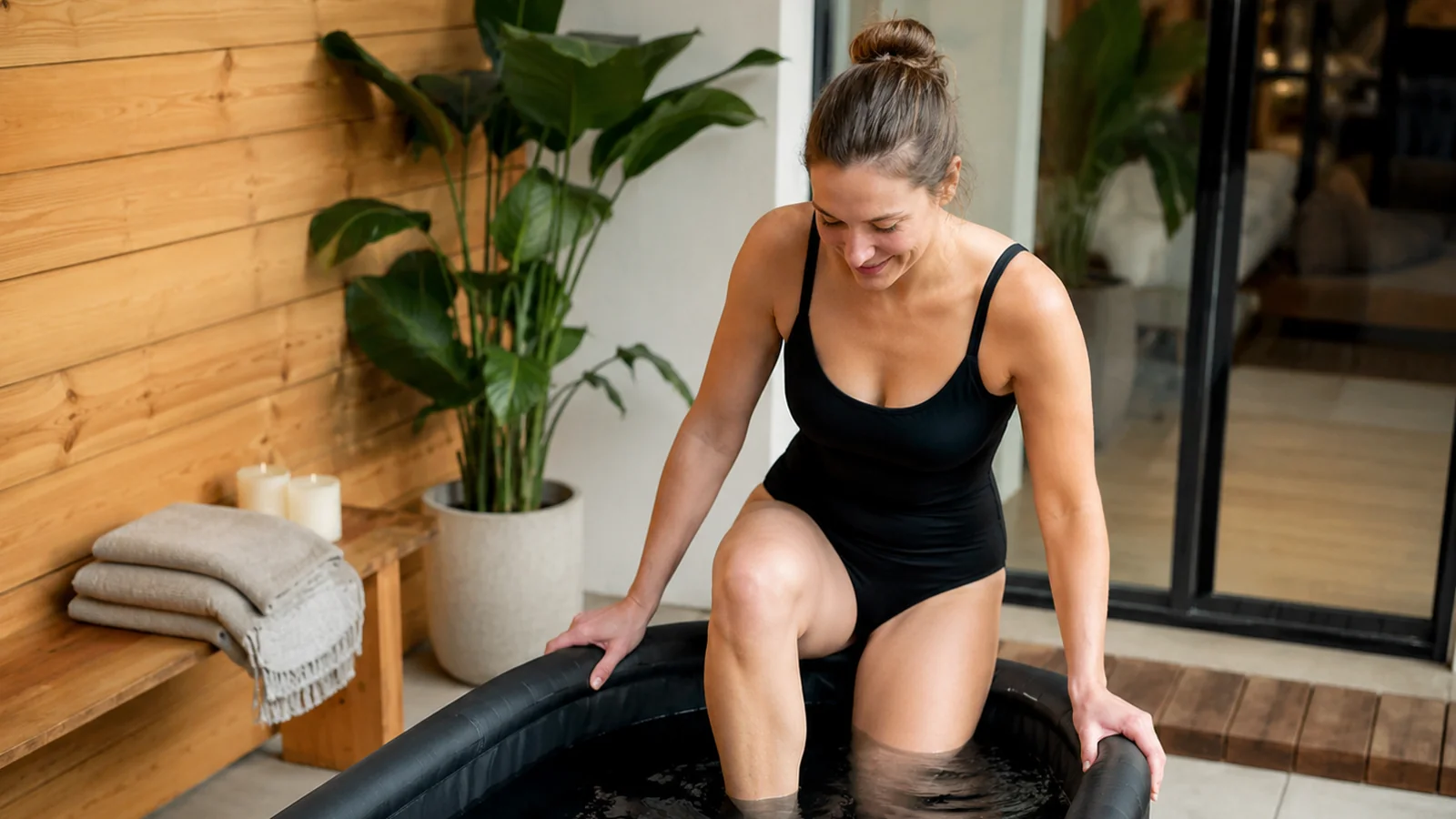
The moment you hit cold water, your body gasps — this is the cold shock response, and it is the single best-documented thing about cold water. It is an involuntary reflex, it peaks in the first 30 seconds or so, and it is what makes cold water genuinely dangerous rather than merely unpleasant. Before you get in, take a few slow breaths. As you enter, exhale slowly and resist the urge to hyperventilate. Entering gradually and staying in control of your breathing is the standard safety advice from water-safety organisations, and it is the reason beginners are told not to plunge alone.
A conservative first-week example
This is an illustration of a cautious start, not a prescription. Reduce it, or skip it entirely, if anything feels wrong.
| Session | Temp | Time |
|---|---|---|
| 1 | 15°C / 59°F | 30 sec |
| 2 | 15°C / 59°F | 45 sec |
| 3 | 14°C / 57°F | 60 sec |
Common beginner mistakes
- Going too cold, too soon. This makes it miserable and unsustainable. Ease in.
- Staying in too long to "prove" something. Longer isn't better and raises risk.
- Holding your breath. Slow exhales, always.
- Plunging right after a heavy workout expecting muscle gains. A controlled trial found cold water immersion immediately after strength training attenuated some muscle adaptation — separate them by a few hours if building muscle is your goal. (See source 3.)
- Warming up too aggressively after. Let your body rewarm naturally; skip the scalding shower straight away.
What gear do you actually need?
To start, almost nothing: a tub, cold water, and ice. You don't need a premium chiller system to begin — in fact we'd suggest against one until you know the habit sticks.
Sources
These are the published sources behind the "what the evidence says" statements above. We link primary literature and water-safety authorities rather than summarising podcasts or social media. PlungeWise is not a medical publisher and has run no studies of its own.
- Tipton MJ, Collier N, Massey H, Corbett J, Harper M. Cold water immersion: kill or cure? Experimental Physiology, 2017. PubMed 28833689 — the cold shock response, its time course, and its role in cold water deaths.
- Espeland D, de Weerd L, Mercer JB. Health effects of voluntary exposure to cold water – a continuing subject of debate. International Journal of Circumpolar Health, 2022. Full text — a review concluding the health effects remain contested and that study designs vary widely.
- Roberts LA, Raastad T, Markworth JF, et al. Post-exercise cold water immersion attenuates acute anabolic signalling and long-term adaptations in muscle to strength training. The Journal of Physiology, 2015. PubMed 26174323 — the basis for separating cold plunging from strength training.
- Søberg S, Löfgren J, Philipsen FE, et al. Altered brown fat thermoregulation and enhanced cold-induced thermogenesis in young, healthy, winter-swimming men. Cell Reports Medicine, 2021. PMC8561167 — the small study that popular summaries condensed into the "11 minutes per week" figure. Read it before treating that number as a target.
- Royal National Lifeboat Institution. The dangers of cold water shock. rnli.org — public water-safety guidance on entering cold water.
Sources last checked July 2026.
This article is general information, not medical advice. It has not been reviewed by a physician, and no medical professional is credited as a reviewer because none has reviewed it. Cold water immersion carries real risks for some people — please consult a healthcare professional before starting a new cold exposure routine.